Pakistan's EV adoption story cannot be told without understanding the global energy backdrop against which it is happening. The post-2022 global energy crisis — triggered by geopolitical conflict, supply chain disruptions, and structural underinvestment in fossil fuel production — has reshaped the economics of vehicle ownership in ways that make electric vehicles more compelling by comparison than they have ever been.
The Fuel Cost Reality
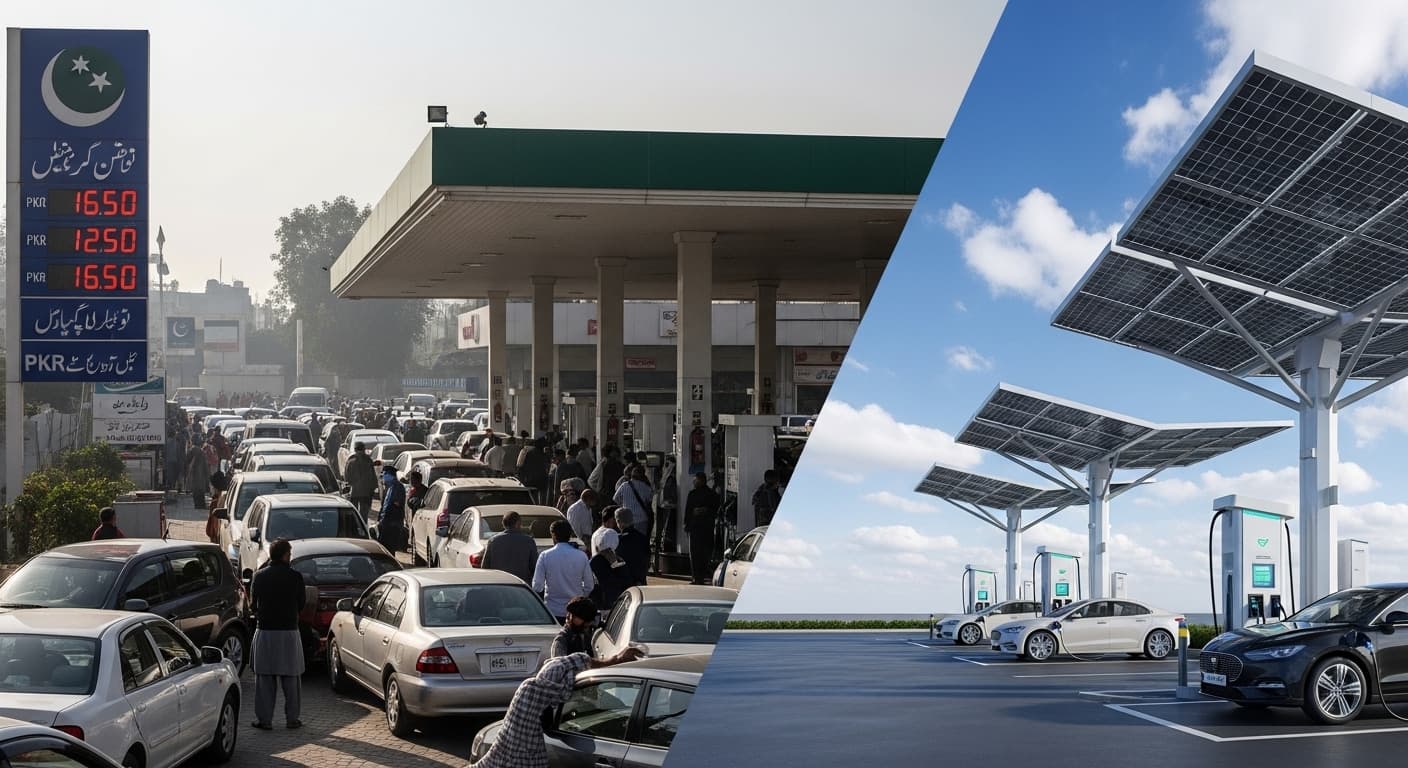
Petrol prices in Pakistan have risen dramatically over the past four years, driven by both global crude price movements and the rupee's significant depreciation against the dollar. Where Pakistani drivers once paid Rs 100–120 per litre, they now pay Rs 280–320 — a near-tripling in nominal terms. For a family running a 1300cc petrol hatchback covering 1,500km per month, monthly fuel costs now exceed Rs 18,000–22,000.
The equivalent cost for an EV owner charging primarily at home: Rs 2,500–4,000 per month, depending on local electricity rates and charging efficiency. The monthly saving — Rs 14,000–18,000 — pays back the EV price premium in three to five years for buyers who can finance the upfront cost.
Energy Security as a National Imperative
Pakistan imports virtually all of its petroleum — spending approximately $17–20 billion per year on fuel imports, a figure that represents a significant portion of total import expenditure and a persistent drag on the current account. Every electric vehicle that replaces a petrol equivalent represents a small but real reduction in that import burden.
At 30% fleet electrification by 2030 — if achieved — the reduction in Pakistan's annual petroleum import bill would be material. The government's EV push is therefore as much a macroeconomic and energy security policy as it is an environmental one. Prime Minister Shehbaz Sharif's directive to fast-track EV adoption needs to be understood in this context.
Solar Charging: The Pakistani Advantage
One aspect of Pakistan's EV transition that is often underappreciated globally is the country's solar energy advantage. Pakistan receives some of the highest solar irradiance levels in Asia, and rooftop solar adoption has accelerated sharply since net metering regulations were introduced. A growing number of Pakistani EV owners are effectively charging their vehicles on self-generated solar electricity — bringing the effective per-kilometre fuel cost close to zero.
This solar-plus-EV combination is genuinely transformative for household economics. It also makes Pakistan's EV transition more resilient to electricity price increases than in countries with less solar resource.
The Tipping Point Approaching
Global energy analysts widely anticipate that the current period of elevated fossil fuel prices will persist for at least the medium term, driven by structural factors that are unlikely to reverse quickly. For Pakistani consumers and policymakers, this creates a rare alignment: environmental goals, economic self-interest, and energy security are all pointing in the same direction. The global energy crisis has not created Pakistan's EV opportunity — but it has made the window for transition wider, the economic case stronger, and the urgency harder to ignore.