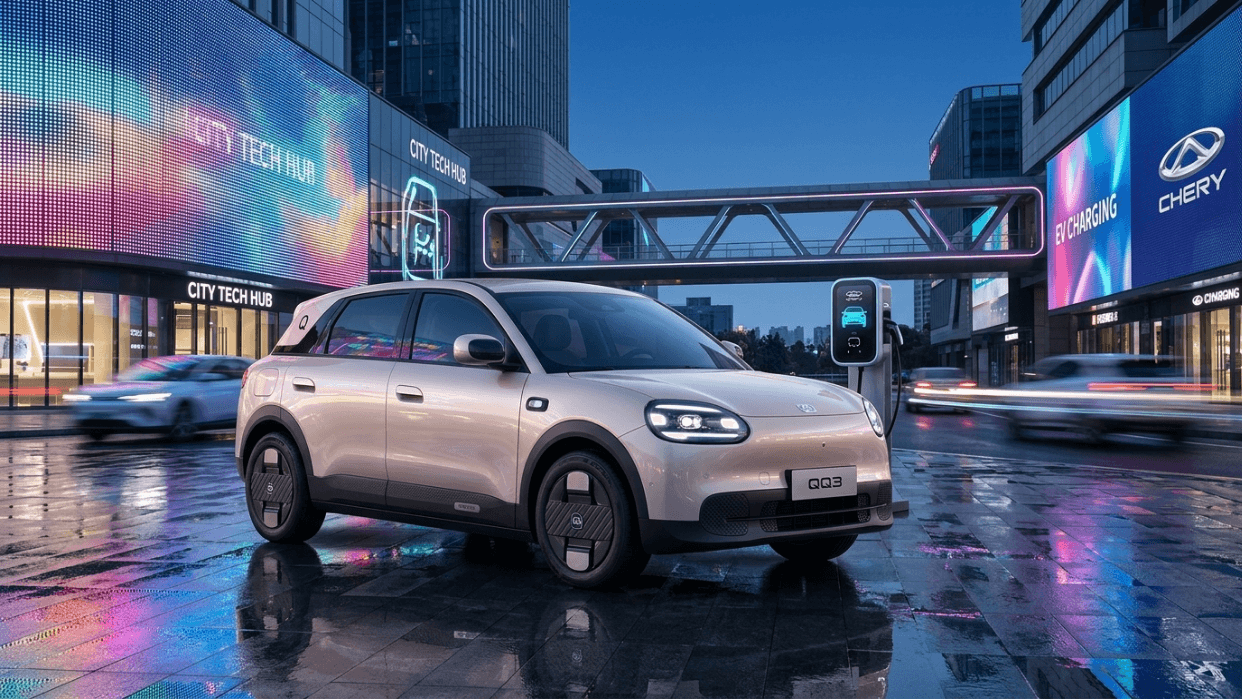
Pakistan's electric vehicle market has so far been defined by premium price tags — the BYD Atto 3 sits above Rs 8 million, the MG ZS EV above Rs 7 million, and anything from BYD's Seal upward is firmly in luxury territory. Chery Master Pakistan's announcement on April 30 could change that calculus significantly. The company confirmed it is bringing the Chery QQ3 electric vehicle to Pakistan — a compact BEV with a 44 kWh battery, 350 km of range, and a price point understood to be around Rs 2.4–2.5 million. That is less than a third of what the cheapest EV currently costs in Pakistan.
If that price holds at launch, the QQ3 would represent a genuine inflection point: the first electric car in Pakistan priced within reach of a buyer who would otherwise be comparing it against a Toyota Corolla or Honda City, not a BYD or MG.
Background: Chery's Position in Pakistan
Chery is not a new name in Pakistan's automotive market. Chery Master Pakistan currently offers the Tiggo 7, Tiggo 8, and Tiggo 9 as plug-in hybrid electric vehicles (PHEVs), having built a measured presence in the premium Chinese SUV segment with dealer and after-sales infrastructure in major cities.
The QQ3 represents a strategic departure for the brand: moving from premium PHEVs to an entry-level pure battery-electric vehicle targeted at urban commuters. CEO Samir Malik described the expansion as reflecting "the company's broader strategy to diversify its offerings by introducing both conventional and electric vehicles while strengthening its position in Pakistan's evolving automotive market."
The QQ3 launched in China in March 2026, recording 56,879 confirmed pre-orders in its first month at a global starting price of approximately USD 8,200. That demand signal — from the world's most competitive EV market — confirms the model's appeal where price-sensitive urban buyers are concerned.
What This Means for Pakistani EV Owners
The gap between where Pakistan's EV market sits today and where it needs to be to hit the government's 30% adoption target is, more than anything else, a price gap. Two-wheelers are already near the tipping point. Four-wheelers are not — because no EV priced at Rs 8–15 million will drive mass adoption in a country where a Rs 3 million petrol car is already a significant household commitment.
The QQ3's Rs 2.4 million price point changes that calculation. At that level, the premium over a comparable petrol hatchback narrows to a range where monthly running cost savings of Rs 3,000–5,000 produce a credible three-to-four-year payback. That is a conversation Pakistan's EV market has not been able to have until now.
For buyers in Lahore and Karachi who drive primarily within city limits, the QQ3's 350 km range covers a full week of typical commuting on a single charge. Home charging on a standard domestic socket overnight is sufficient — no dedicated wallbox required. This is a practical urban EV built for the kind of driving most Pakistanis actually do.
Key Details and Numbers
Based on the confirmed global specification, the Chery QQ3 brings the following to Pakistan:
- Battery: 44 kWh lithium-ion
- Range: 350 km (CLTC test cycle; real-world estimate 280–310 km)
- Motor output: 100 kW
- Acceleration: 0–100 km/h in under 10 seconds
- Fast charging: 80% charge in approximately 30 minutes on a DC fast charger
- Interior: Dual-screen digital setup, wireless phone charger, automatic boot and frunk
- Expected Pakistan price: Approximately Rs 2,400,000–2,500,000
- Expected launch timeline: September–October 2026
The 30-minute DC fast charge capability is directly relevant to Pakistan's existing infrastructure. Public fast chargers on the major motorway corridors and in Lahore, Karachi, and Islamabad are compatible with the QQ3's charge standard. Check EV charging prices and locations to plan charging stops on longer routes. A half-hour stop adds approximately 200–230 km of range — adequate for inter-city travel on established charging corridors.
What Happens Next
Chery Master Pakistan has not announced a specific launch date. The stated 5–6 month timeline from the April 30 announcement places the QQ3 debut in September or October 2026. Bookings are expected to open ahead of that, with launch events likely in Karachi and Lahore simultaneously.
The final retail price depends significantly on how Pakistan's customs authorities classify the QQ3 under the NEV Policy 2025–30. The policy provides reduced CBU import duties for electric vehicles, and the applicable rate for a vehicle of this battery capacity will determine whether the Rs 2.4 million price point holds. Chery Master is expected to seek the most favourable classification available.
Alongside the QQ3, Chery Master also confirmed it is bringing the Tiggo 4 CSH — a conventional hybrid compact SUV — to Pakistan, likely in 2027. Together, the two new models extend Chery's range downward into non-PHEV territory for the first time in Pakistan's market.
When will the Chery QQ3 EV launch in Pakistan?
Chery Master Pakistan confirmed on April 30, 2026 that the QQ3 is coming. Based on the 5–6 month window given, the launch is expected around September to October 2026. No formal booking date has been announced yet.
What is the expected price of the Chery QQ3 in Pakistan?
Early market listings indicate a price in the Rs 2,400,000–2,500,000 range. This has not been officially confirmed by Chery Master Pakistan. The final price will depend on import duty classification under the NEV Policy 2025–30.
How far can the QQ3 travel on a single charge?
The QQ3 carries a 44 kWh battery with a rated range of 350 km under Chinese CLTC test conditions. Real-world range in Pakistani urban driving is likely 280–310 km — sufficient for city use and for inter-city trips on routes with fast charging infrastructure.
Can the QQ3 charge at Pakistan's public charging stations?
Yes. The QQ3 supports standard AC charging and DC fast charging. Pakistan's public DC fast chargers at PSO, HUBCO Green, and Shell Recharge stations on motorways and in major cities are compatible. The QQ3 reaches 80% charge in approximately 30 minutes on a DC fast charger.
How does the QQ3 compare to the BYD Atto 3?
They are not direct competitors. The QQ3 is a compact city car — smaller, lighter, shorter range, and around Rs 6 million cheaper than the Atto 3 SUV. The QQ3 opens EV ownership to buyers for whom the Atto 3 is simply out of budget. If Pakistan's EV market is to move beyond early adopters and fleet buyers, the QQ3's price segment is precisely where growth needs to happen.